First-Time Moms With Bachelor’s Degrees More Likely to Be Married Than Those Without. [REPORT]
December 17, 2025

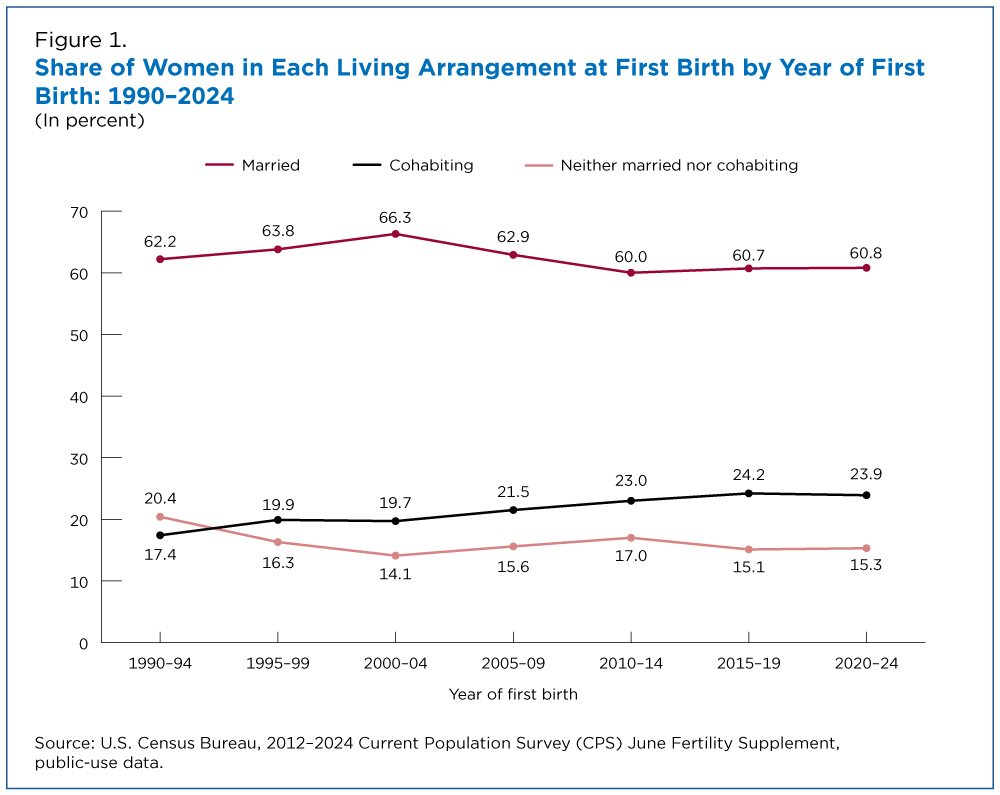
About a quarter (24%) of women who had their first child from 2020 to 2024 lived with an unmarried partner, up from around 17% in the early 1990s, according to a new U.S. Census Bureau report.
But a smaller share of women had their first child while neither married nor living with a partner, dropping from roughly 20% to about 15% in 30 years.
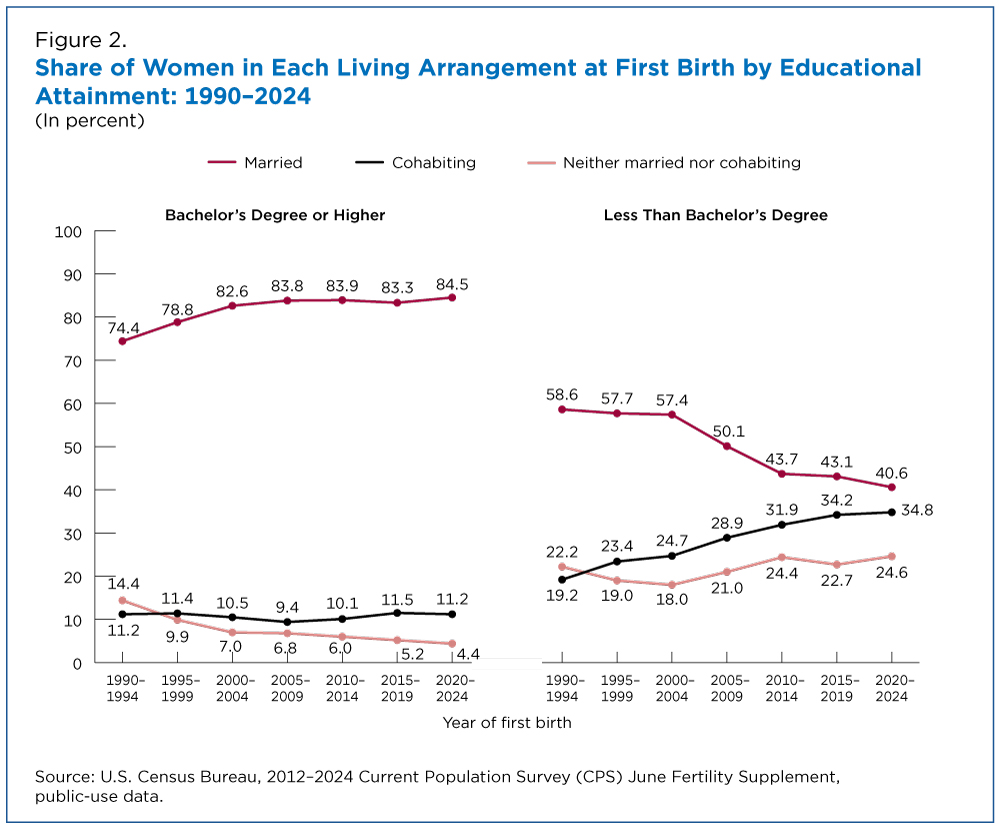
From 2020 to 2024, only about 4% of first-time mothers with a bachelor’s degree or higher were neither married nor living with a partner, and roughly 11% were cohabiting.
During the same time, the estimated share of first-time mothers who were married at the time of birth remained at approximately 60%.
Mothers’ Education
Over the years, it also became more common among women with a bachelor’s degree or higher to be married at first birth, with the share jumping from about 75% in the early 1990s to roughly 85% this decade.
From 2020 to 2024, only about 4% of first-time mothers with a bachelor’s degree or higher were neither married nor living with a partner, and roughly 11% were cohabiting.
The opposite occurred among those with less than a bachelor’s degree: fewer were married at first birth (roughly 40% this decade compared to about 60%) but the share living with a partner rose from about 20% to 35%.
These educational differences highlight a growing divide in family stability: socioeconomically advantaged individuals are increasingly likely – and their less advantaged peers decreasingly likely – to be in stable arrangements such as marriage.
Other highlights:
- Between 2020 and 2024, Asian mothers were the most likely to be married at first birth (87.1%), followed by White (71.3%), Hispanic (43.9%) and Black mothers (29.0%), though the difference between Hispanic and Black mothers is not statistically significant.
- Approximately 40% of first-time Black mothers were neither married nor cohabiting at the time of childbirth in 2020-2024, followed by Hispanic (22.2%), White (8.5%) and Asian mothers (5.5%). However, the difference between White and Asian mothers is not statistically significant.
To download report, CLICK HERE.