In Latin America, when violence rises, women’s economic opportunities fall
March 10, 2026

Violence as an economic constraint
LAC is one of the most violent regions in the world. Beyond homicides and visible insecurity, violence manifests through fear, harassment, and intimate partner violence – factors that directly shape women’s economic behavior. Even when women are not direct victims, the broader climate of violence influences where they can go, what jobs they can take, and how they allocate their time. The result is, violence affects women’s labor supply, earnings, productivity, and long-term attachment to the labor market. These effects accumulate over the life course, limiting economic independence and reinforcing inequality within households and across generations.
How crime affects women’s work: six key mechanisms
New research identifies six interrelated mechanisms (Figure1) through which violence and insecurity shape women’s economic outcomes.
Figure 1. Mechanisms through which violent crime differentially impacts the labor outcomes of men and women.
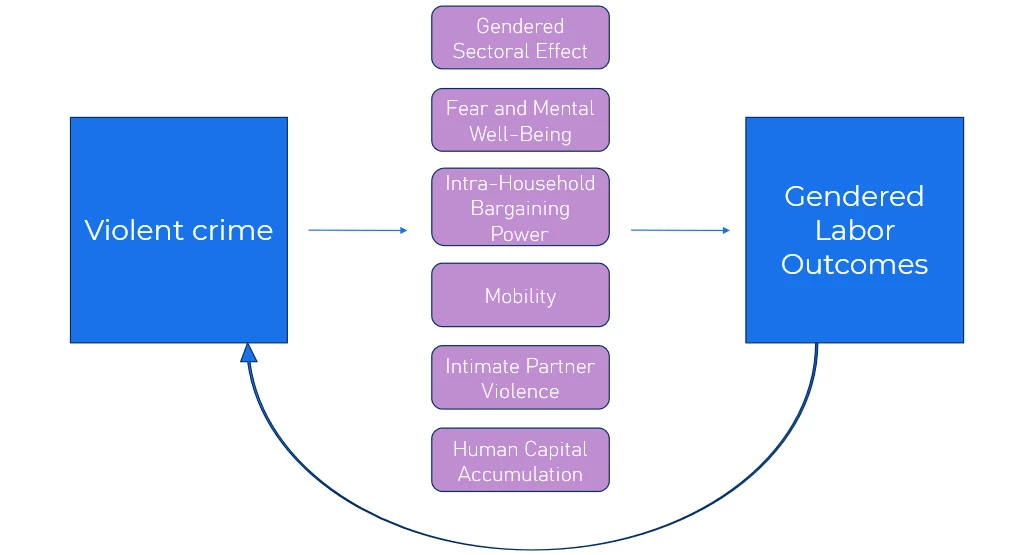
- Sectoral segregation: Women in LAC are disproportionately concentrated in low-paid, informal service sectors – such as retail, hospitality, and domestic work – that are particularly vulnerable to crime and economic disruption. When violence rises, these sectors are often the first to contract, pushing women out of work or into even more precarious employment.
- Fear of victimization and mental well-being: Fear of victimization and the stress that accompanies it also alter decisions about work. Women are more likely than men to respond to insecurity by reducing working hours or exiting the labor force altogether, particularly if they are self-employed or working informally. This often leads to a reallocation of time from paid employment to unpaid domestic and care work, reducing women’s economic autonomy.
- Mobility constraints: Concerns about personal safety and harassment, limit women’s use of public transportation, night travel, and commuting to distant jobs. Fewer feasible, safe routes translate into fewer accessible jobs, reinforcing occupational segregation and limiting earnings potential.
- Intimate partner violence: A broader climate of violence is associated with higher risks of intimate partner violence (IPV), with profound economic consequences. IPV undermines women’s ability to remain employed through absenteeism, reduced productivity, job exits, and long-lasting mental health consequences. Even when violence occurs at home rather than in the workplace, it weakens women’s economic autonomy.
- Intra-household bargaining power: These pressures reverberate inside households. As insecurity increases and women’s earnings decline, their influence over employment decisions, spending, and time allocation often declines. Weakened bargaining power creates feedback loops that further restrict women’s labor market participation.
- Human capital accumulation: Violence also affects future economic outcomes by disrupting education. Safety concerns, displacement, caregiving responsibilities, and restrictive social norms can disrupt girls’ schooling and skill development. These early setbacks translate into weaker labor market outcomes later in life, reinforcing intergenerational inequality.
A reinforcing cycle between violence and opportunity
The relationship between crime and economic outcomes runs in both directions. Limited labor market opportunities – especially for young men – can contribute to violence. Rising violence, in turn, reduces women’s participation in paid work, increases unpaid care burdens, and weakens household stability. Without targeted intervention, countries risk becoming trapped in a vicious cycle in which insecurity undermines economic opportunity and weak economic prospects sustain conditions for continued violence.
Laws and institutions matter
Breaking this cycle requires more than general crime reduction strategies. Legal and institutional frameworks determine how violence translates into economic outcomes for women. Evidence from the World Bank’s Women, Business and the Law report highlights that countries with high levels of violence often lack comprehensive legal protections related to gender-based violence, labor rights, childcare, and family law (Figure 2). Even where laws exist, weak enforcement, limited budgets, and institutional gaps frequently prevent women from exercising their rights in practice.
In high-crime settings, these weaknesses amplify vulnerability, making it harder for women to remain in work, transition to safer jobs, or build economic resilience.
Figure 2. Countries with higher homicide rates tend to have weaker legal protections for women
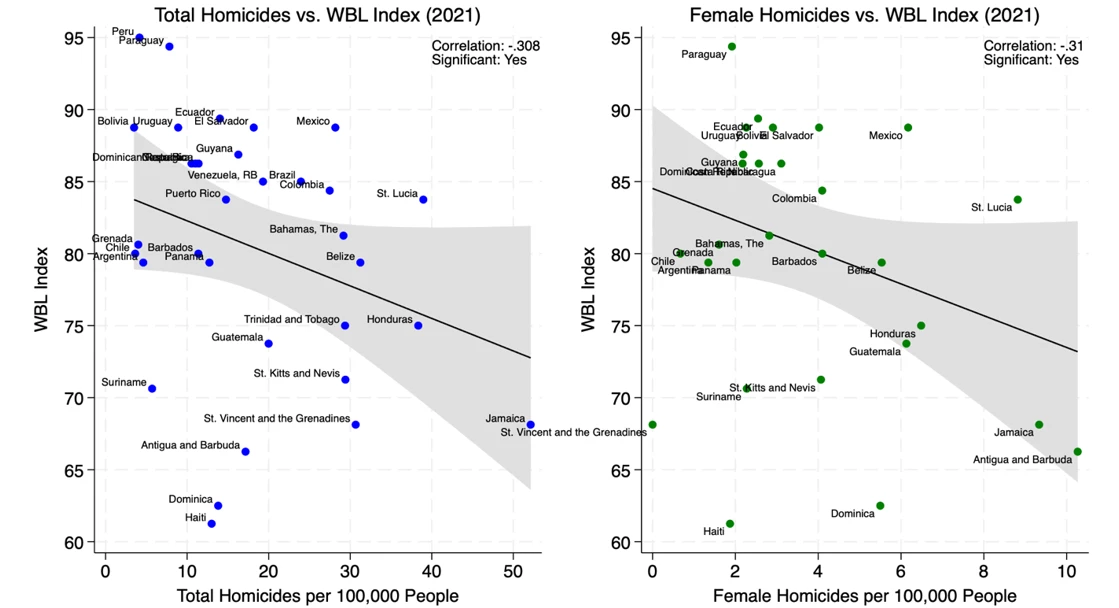 Note: WBL 2023 data.
What works
Addressing the economic impacts of violence on women requires coordinated policies that link security, services, and economic opportunity.
- Active labor market policies can help women transition into safer, more stable, and better-paid jobs.
- Investments in childcare and care systems are essential to reduce unpaid work burdens and strengthen attachment to work, especially during periods of heightened insecurity.
- Trauma-informed mental health services and survivor-centered justice responses can support economic reintegration and protect continuity of employment.
- Stronger legal frameworks with real enforcement are central – closing gaps in gender-based violence legislation, labor protections, childcare provision, and family law, and backing reforms with budgets and accountability.
- Efforts to shift social norms that perpetuate violence and harassment, engaging men and communities to shift behaviors at home, in workplaces, and in public spaces. Implementation should prioritize the neighborhoods and sectors where violence and female employment intersect most acutely.