In the United States, language tells a powerful story about culture, identity, and opportunity.
February 24, 2026
 By Grace Agostino
I don’t usually post on weekends – but today is an exception.
February 21 is International Mother Language Day, a global observance proclaimed by UNESCO and adopted by the United Nations to celebrate linguistic diversity and inclusion.
In the United States, language tells a powerful story about culture, identity, and opportunity.
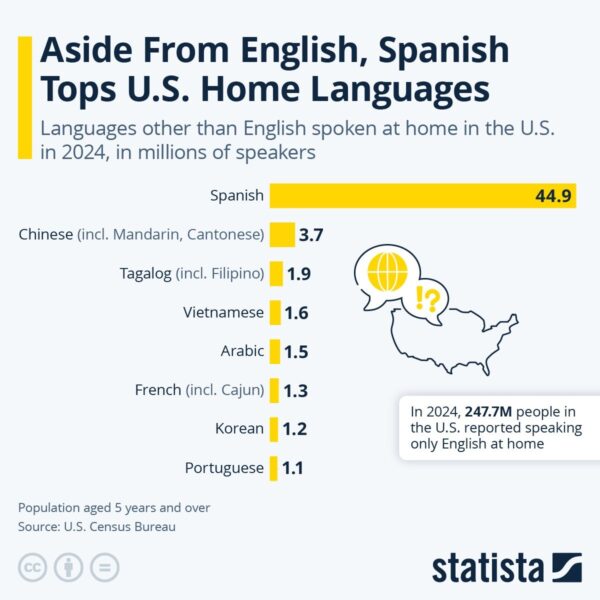
While 247.7 million Americans report speaking only English at home, tens of millions maintain other languages within their households ; preserving heritage across generations.
Spanish stands in a category of its own.
Nearly 45 million people speak Spanish at home, making it by far the most widely spoken non-English language in America -not a niche audience, but a massive, mainstream one embedded across regions, industries, and income levels.
Chinese languages (Mandarin and Cantonese) rank a distant second at 3.7 million speakers.
For brands and media planners, this isn’t just an interesting statistic -it’s a strategic signal.
Spanish-language media deserves serious consideration not as a specialty channel, but as a core component of any national strategy targeting growth, relevance, and trust.
At the same time, language alone is not a proxy for culture. Many Hispanic households are bilingual or English-dominant, moving fluidly between languages depending on context, generation, and platform. Effective engagement requires a layered approach that combines language, cultural insight, and authentic representation.
Where Spanish media often plays a unique role is in moments of trust -family decisions, financial conversations, healthcare, news, and community issues. These are not just media impressions; they are relationship touchpoints.
On a day dedicated to mother languages, one lesson stands out:
Language is not only how people communicate – it’s how they feel understood.
Brands that recognize this don’t simply translate messages.
They design strategies that reflect how people actually live, speak, and decide.
America’s linguistic diversity is not a complication to work around.
It is one of the country’s greatest competitive advantages.
Sources:
U.S. Census Bureau, American Community Survey (ACS) 2024 — Languages Spoken at Home
UNESCO — International Mother Language Day
Statista visualization of ACS data