The Quiet Power of a Positive Outlook
April 8, 2026
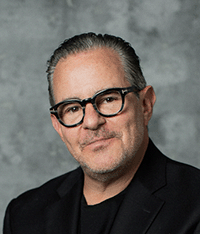
By Luis Miguel Messianu
Uncertainty no longer knocks—it lives with us. It sits in our newsfeeds, our plans, our silences. The world feels like it’s constantly shifting under our feet, and some days it’s hard to tell what will change next, or how. Yet, somewhere in all this noise, there is still a whisper worth listening to: we remain in charge of how we see the world.
That’s where the quiet power of a positive outlook begins. It does not deny the turbulence. It doesn’t pretend everything is fine. Instead, it asks a different question: Given all this, who do I choose to be?
A positive outlook is not naïveté; it’s rebellion. It’s the refusal to let fear edit our story. It’s the decision to look forward when everything around us insists on looking down. Realists describe the world as it is; those with a positive outlook help build the world as it could be.
In my world—the world of creativity, ideas, and brands—this outlook is not a nice-to-have, it’s fuel. It’s what turns impossible briefs into surprising solutions. It’s what helps us see potential in places others overlook: in new voices, in underrepresented communities, in markets that don’t yet have a name. A positive outlook doesn’t ignore risk; it just refuses to let risk be the only lens.
I’ve seen it time and again. Two teams, facing the same challenge: shrinking budgets, high expectations, and a brutal timeline. One team spirals into cynicism—every obstacle becomes proof that “this will never work.” The other acknowledges the constraints, then asks, “What can we still make happen?” Same reality, radically different results. The difference wasn’t talent. It was outlook.
Those of us who grew up between cultures understand this at a deeper level. We learned early on that change is not an exception—it’s the norm. New language, new rules, new codes to decode. Out of that instability, many of us developed something like a quiet superpower: the ability to find a center within ourselves, even when the outside world felt unstable.
In our communities, a positive outlook is often embedded in everyday gestures. The way a family hosts a gathering even in tight times. The way humor surfaces in the middle of hardship. The way we talk about “salir adelante”—moving forward—not as a fantasy, but as a stubborn, almost sacred obligation. That cultural instinct to believe in tomorrow, even when today is difficult, is a form of wisdom we sometimes underestimate.
This doesn’t mean closing our eyes to injustice, inequality, or pain. On the contrary, a genuine positive outlook requires that we see reality clearly. It asks us to stand in front of the full picture—the beauty and the brokenness—and still choose to engage, to contribute, to care. It’s not “toxic positivity.” It’s not pretending everything is okay. It’s saying: even if everything is not okay, I will not let that cancel my capacity to act with hope.
There is also something profoundly practical about guarding our outlook. When we let negativity run the show, our world shrinks. We see fewer options, fewer allies, fewer exits. Our thinking narrows. When we cultivate a more open, hopeful perspective, we see more paths, more partners, more possibilities. A positive outlook won’t fix everything. But it will make us more capable of navigating anything.
So yes—be aware, be vigilant. Read the signs, understand the risks, protect what needs protecting. But don’t surrender your faith in what can be. A positive outlook is not the absence of struggle; it’s the poetry of survival. It’s the choice to remain human in systems that often push us toward numbness or despair.
Maybe that’s what this moment is really asking of us:
- to dream louder than doubt,
- to light a candle when others predict darkness,
- to lead not from fear, but from vision.
In our roles—as leaders, as creators, as citizens, as simply human beings—we have more influence than we think. Every time we choose our outlook, we’re quietly shaping the atmosphere around us. We’re deciding whether people leave our presence a little heavier, or a little lighter.
Let’s keep rebelling, softly but firmly—with ideas, with hope, with love. Let’s dare to design conversations, teams, and communities where the default is not cynicism, but curiosity; not resignation, but resolve.
Because a positive outlook is the most creative act of all.
It is how we invent tomorrow—starting from the only place we ever truly control: the way we choose to see today.