What Radio Listeners Told Us About Their Social Media Habits
April 22, 2026
 By Katie Miller, VP of Strategy, Crowd React Media
What Radio Listeners Actually Use (The Short Answer)
YouTube dominates radio listener social media habits in 2026, with 83% of U.S. radio listeners 18+ using it weekly. This beats Instagram (77%), Facebook (73%), and TikTok (72%). Spanish-language radio listeners show distinct platform preferences, with 59% using WhatsApp weekly versus 39% of English-language listeners. Radio stations investing heavily in TikTok while ignoring YouTube are chasing the wrong platform. These findings come from surveying 2,798 radio listeners across the U.S. in March-April 2026.
Social media shifts fast. What worked for your audience last year might not work now, which is why we regularly check in on where radio listeners actually spend their time online.
In the latest Media Minute from Crowd React Media, we talked to 2,800 radio listeners 18+ in the U.S. between March and April 2026. And the data reveals something radio programmers need to see: while the industry obsesses over TikTok strategy, 83% of radio listeners are using YouTube every single week. YouTube beats all the platforms radio chases, and most stations are barely paying attention.
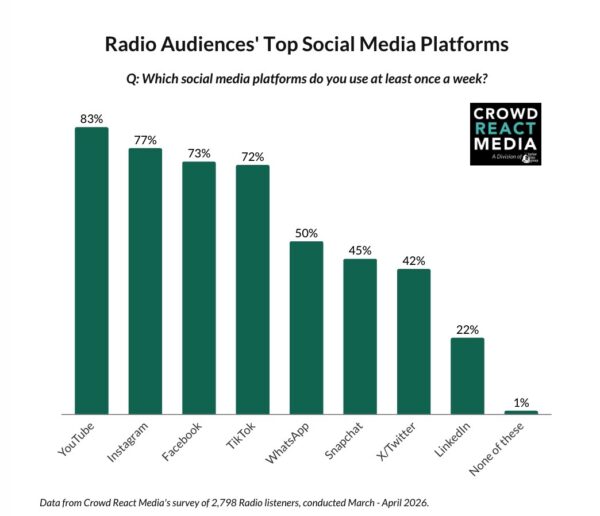
Here’s the full picture of weekly social media use among radio listeners:
- YouTube: 83%
- Instagram: 77%
- Facebook: 73%
- TikTok: 72%
- WhatsApp: 50%
- Snapchat: 45%
- X/Twitter: 42%
- LinkedIn: 22%
Only 1% of radio listeners said they use none of these platforms weekly. Your audience is online, they’re active, and they’re using multiple platforms. So when you’re deciding where to invest your time and content, go where they already are.
Stop Spreading Yourself Thin
Most radio stations try to maintain a presence everywhere. Facebook page, Instagram account, TikTok experiments, X feed, LinkedIn company page. The problem is that equal effort across unequal platforms is a losing strategy, and the data makes that pretty clear.
If 83% of your audience is on YouTube weekly and only 22% is on LinkedIn, your content calendar needs to reflect that gap. YouTube offers longer content windows, better discoverability, and audience behavior that aligns with how people consume radio content — lean-back, audio-forward, exploratory. Yet most stations treat it as an afterthought while agonizing over 15-second TikTok vertical video strategies that may or may not land.
The WhatsApp Opportunity for Spanish-Language Radio
When we break the data down by language, one platform really stands out: WhatsApp.
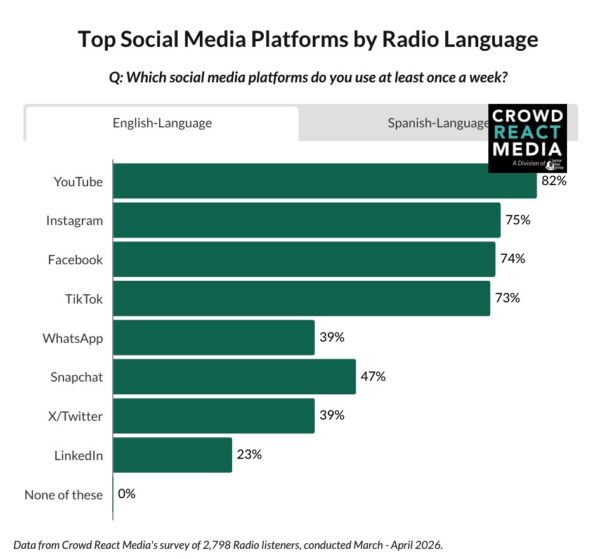
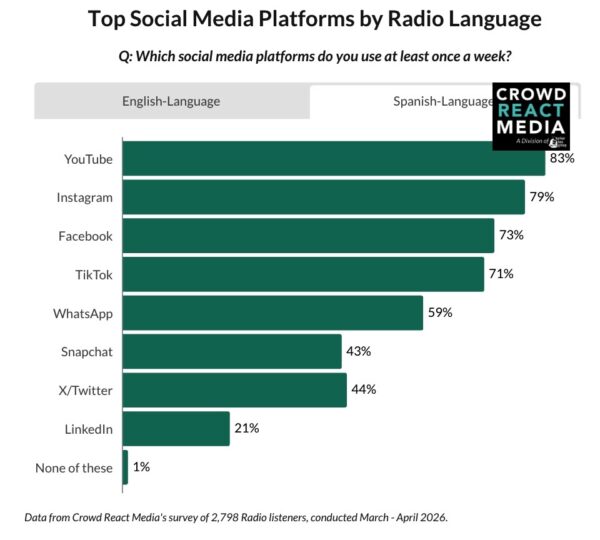
Click on “English-Language Radio” and “Spanish-Language Radio” tabs on graph to toggle between.
Among Spanish-language radio listeners, 59% use WhatsApp weekly compared to just 39% of English-language listeners. That 20-point gap represents a real opportunity for bilingual and Spanish-language stations. For this audience, WhatsApp is nearly as ubiquitous as Facebook (73%). If you’re serving Spanish-language markets and treating WhatsApp as a secondary platform, you’re leaving reach on the table.
If You Do Invest in TikTok, Go Local
TikTok Nearby is the feature most radio stations don’t know exists, but it’s worth understanding if you’re committing resources to the platform. It surfaces local content based on user location, which means you can reach people in your broadcast area instead of competing with creators worldwide. If you’re investing time in TikTok — and 72% of your audience is there weekly, so it’s worth considering — use the one feature that plays to radio’s geographic advantage.
National Trends, Local Answers
This data shows where radio listeners are nationally, but your audience is hyperlocal. Want to know exactly which platforms your listeners use in your market? We build custom research studies that give you market-specific answers instead of industry averages. Learn more about strategic studies here.
This research was conducted by Crowd React Media, a division of Harker Bos Group in March and April 2026 with 2,798 radio listeners age 18+ across the US, including both English-language and Spanish-language radio audiences.