What Creatives Really Want from Planners
 If I asked a group of ad planners what the one thing they most want from their creative partners, it’d be ‘collaboration.’ That’s because, like it or not, there is a deep insecurity lurking that whatever brilliant brief we arrive at will be completely ripped apart — or worse, ignored — by the creative people it is intended to inspire. Maybe it’s the intangibility of strategy — its ambiguity in the creative process — that makes us seek any evidence of our value to others. By Ed Tsue- Anomaly / Group Strategy Director / Managing Director
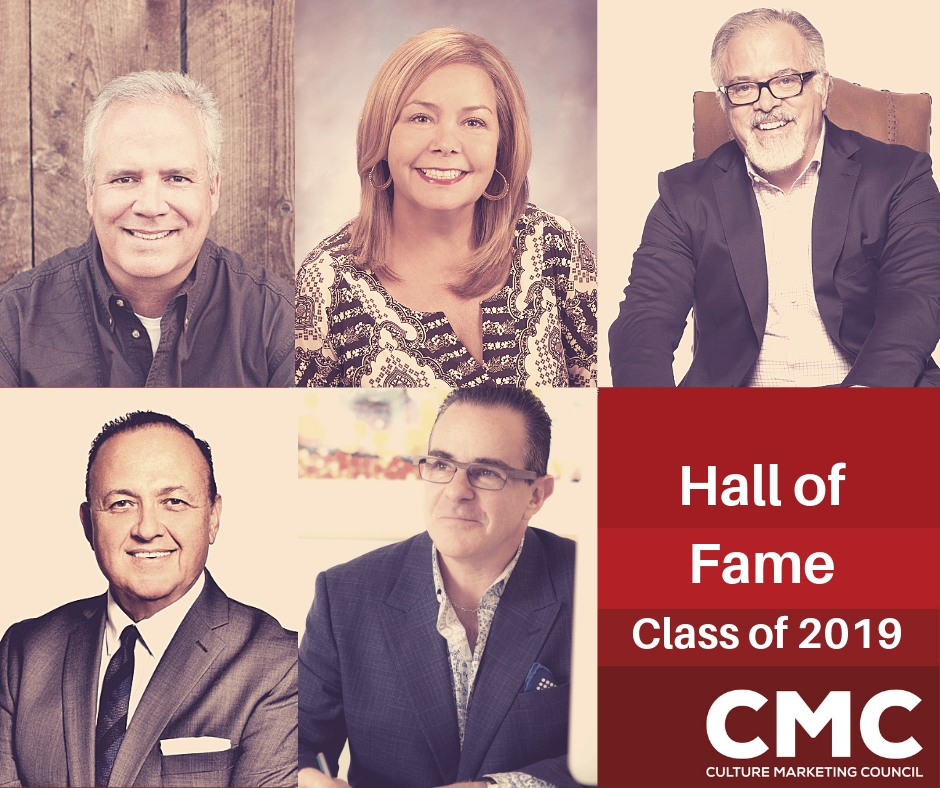 The Culture Marketing Council: The Voice of Hispanic Marketing (CMC) announced the 2019 inductees of the CMC Hall of Fame, which recognizes a select group of visionaries, leaders and luminaries who have made significant contributions to the development and advancement of the Hispanic advertising and marketing field. Sponsored by State Farm, the CMC Hall of Fame welcomes agency pioneers and creative mavens Al Aguilar, Tony Dieste, Alex Lopez Negrete, Luis Miguel Messianu, and Ingrid Otero-Smart. All inductees will be recognized during an awards gala at the 2019 CMC Annual Summit, taking place on Tuesday, June 11, at the Statler Hotel in Dallas, Texas.
 CMO Council Research Lists Amazon, Starbucks and Apple as Leaders in Guiding the Customer Journey and Using Experience for Competitive Advantage; Issues Call to Action for Brands to Identify Micro-Moments of Opportunity to Further “Human” Relationships
 With newer generations coming into the consumer fold, the U.S.’ mosaic of buyers grows more diverse. As such, measuring these audiences has become increasingly pertinent—not only because of the value of representation, but because these audiences are helping to shape the future of how we consume and communicate. Women and multicultural consumers have become a driving force in tech and media, particularly when it comes to handheld devices. Mobile devices’ avenues for content and their wide availability are giving power to these diverse groups.
 In most professions, men hold the vast majority of CEO positions. It’s no exception in public relations, where current research shows that nearly 80 percent of chief executives are male. In an industry that is predominantly women, the leadership gap is especially pronounced.
 The Hispanic community in the United States has contributed significantly to US economic growth in recent decades and will continue to do so over the next 10 to 20 years. This contribution derives partially from demographic vitality: the fact that Hispanics are the youngest and largest minority group in America and are on a path toward becoming an increasingly large share of the US labor force. Higher fertility rates, net immigration, and growing labor force participation rates will reinforce this trend. This paper presents evidence showing that Hispanic educational attainments are now rapidly converging to the US average. By Gonzalo Huertas (PIIE) and Jacob Funk Kirkegaard (PIIE)
 What motivates consumers? Video consumption has never been more fragmented. As pay TV subscriptions continue to decline, they are replaced by a number of live and on-demand streaming options that continue to grow by the day. Viewers can use a dizzying array of services to create their own consumption “nirvana.” However, there is bound to be an upper limit on both how many different services a consumer is willing to pay for and how much time she has in the day to consume. This leads some in the industry to believe the growth in content and platforms may not be sustainable over the long term.
 In a recent article on Campaign Live Rory Sutherland suggests that we all adopt “the efficiency bubble” to describe the way media logistics, not creativity, have come to dominate the conversation about advertising. But our fixation on efficiency is not just a bubble, it is a trap. by Nigel Hollis
 Changing consumer behaviors and the ever-shifting digital frontier are demanding new marketing capabilities and new ways of working with agencies.
 Companies spent more than $1 trillion globally on marketing in 2017, by one estimate. This puts chief marketing officers stewarding their brands squarely in the crosshairs of CEOs, CFOs and corporate boards, who want to know where all this money is going and what they’re getting in return—“brands be damned.”
 The U.S. Census Bureau released results from the 2020 Census Barriers, Attitudes and Motivators Study (CBAMS). The national survey and series of focus groups were designed to better understand the nation’s attitudes toward the 2020 Census, potential barriers that may inhibit participation, and possible motivators of responding.
 Sales alone are not the sole measure of success when a brand launches a new product. To truly understand the value of innovation, we need to understand its category impact—and that means measuring incremental innovation.
 As people conduct ever more of their lives as consumers and social animals online, they leave telling and durable traces of their behaviors, values, and inclinations behind them in digital repositories. Marketers have not been slow to recognize the opportunities presented by this information or to capitalize on them.
 iProspect released their fourth annual whitepaper, 2019 Future Focus: Searching for Trust, built to help marketers navigate and master the notions of truth and authenticity in the hyper-sensitive global media landscape today. The report predicts that those businesses grounded in credibility, relevance and reliability across all their marketing channels will see trust at the very foundation for their success in the digital economy.
  In a survey of 412 US client-side marketers conducted by the Association of National Advertisers (ANA), 78% of respondents claimed to use an in-house agency, up from 58% in 2013. (An “in-house agency” is defined as a department, group, or person who has responsibilities that are typically performed by an external advertising or other communications agency.)
 The new report finds that fast food, candy, sugary drinks, and unhealthy snacks represented 86 percent of food ad spending on Black-targeted TV programming, where Black consumers comprise the majority of viewers, and 82 percent of ad spending on Spanish-language TV, in 2017. According to researchers, food companies spent almost $11 billion in total TV advertising in 2017, including $1.1 billion on advertising in Black-targeted and Spanish-language TV programming.