Women Want Recipes from Food Brands
Social media users who connect with brands often share a desire for coupons and offers—they’re in it for the deals. But for food brands, there’s another key way to connect with women online: recipes.
Consumers have a more positive outlook going into this holiday season, according to the 2015 Holiday Purchase Intentions Survey from global information company The NPD Group.
T
he Telemundo Station Group announced the promotions of Michael Chico to Executive Vice President of Sales; Amanda Calpin to Chief Financial Officer; and Osvaldo “Ozzie” Martinez to Senior Vice President of News, Digital and Standards.
Much talk has surfaced lately about the whether it makes sense to have a total market strategy. Some contend that the intent of a “total market” strategy, which is to recognize target consumers’ needs, culture and behavioral characteristics in the formulation of a company’s marketing strategy is more often misunderstood or not understood at all. This has resulted in “total market” strategies which homogenize how organizations communicate with consumers and which under emphasize and even ignore cultural nuances that work to powerfully connect consumers and brands. By Terry Soto is President and CEO of About Marketing Solutions, Inc.
Virtually every brand we work with is trying to win Millennials and it’s not surprising why. Eighty million shoppers with one trillion dollars in buying power are hard to ignore. But equally hard to ignore are recent stats that show when it comes to shopper marketing, Millennials know what they want.
Not surprisingly, Americans are spending an increasing share of their time on their mobile devices. But according to the latest eMarketer forecast, the channel’s growth rate is slowing considerably.
Sir Martin Sorrell has a strong point of view on the names of things. Here he is on linking his own company with the term “advertising”: “We need to rename it because it encourages people to think that creativity is the preserve or reserve of that creative department, of that creative director in that so-called ad agency,” said the WPP Group chief executive at an Advertising Week event.
Edelman revealed the results from its ninth annual entertainment study, which found that when it comes to creating entertaining content, consumers equally trust content creators, distributors and brands (72 percent trust traditional cable networks; 73 percent trust traditional broadcast networks; 74 percent trust online video streaming platforms; 75 percent trust companies whose products they buy).
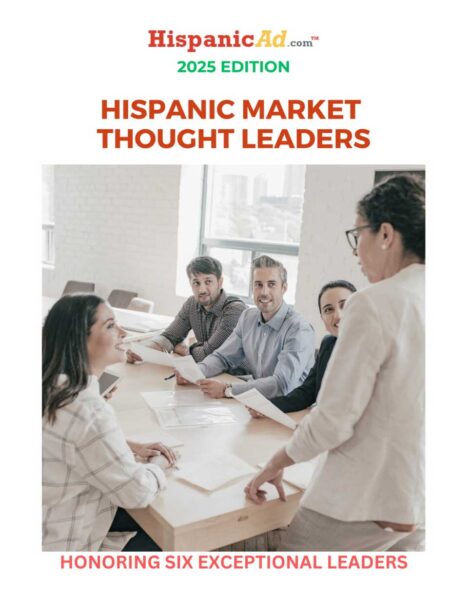
Hispanic Media Sales, Inc., publishers of HispanicAd.com, will be publishing this year;s edition on November 9, 2015. We will be adding more “Thought Leadership” once again to this year’s edition. We will interview the Top Hispanic CMOs with dedicated budgets and resources targeting the US Hispanic Consumer. Gilbert Davila, a recognized and admired Hispanic Market expert, will curate the supplement. Adam Jacobson, a respected writer and US Hispanic media expert will conduct the interviews and write the supplement.
Our industry trades on ideas. Oftentimes, we compete to win or lose based on the quality of those ideas. Creative ideas. Media ideas. Social ideas. But the typical path to get to big ideas has been to perfect something for one channel, then think of the extensions that amplify it in the store, on the web and everywhere in between.
The visual web is many things to many people—and marketers. According to September 2015 polling, most US brand marketers can’t put just one definition to the term: It includes design, advertising and even anthropological phenomena. What is clear is that it’s important.
David Morse, president and CEO of New American Dimensions, has been selected to receive the Founder’s Award from Mshale Newspaper, the African community newspaper based in the Twin Cities.
By Gonzalo López Martí / LMMIAMI.COM
Although stereotyped frequently as an irrationally optimistic, self-centered and monolithic market segment, millennials are, rather, a highly-educated, technology-embracing, well-diversified set of pragmatics that demand personalized engagement.
Music marketing and brand experience agency Momentum Worldwide has conducted a research study aimed specifically at identifying the connection between live and digital music behaviors. Among the findings is that millennials, defined as people ages 18-34, want to see brands in the music space and enjoy seeing them there.
Adolescence is a time of incredibly physical, social and emotional growth, and peer relationships – especially romantic ones – are a major social focus for many youth. Understanding the role social and digital media play in these romantic relationships is critical, given how deeply enmeshed these technology tools are in lives of American youth and how rapidly these platforms and devices change.
“Both Head and Heart” looks at marketing strategies designed to broadly connect with diverse audiences and the subsequent emergence of “Total Market.”
The roughly one in four Americans expecting the economy to improve in the coming year is all but unchanged from June (26%, vs. 25% in June). However, pessimism continues to grow, with three in ten Americans expecting the economy to get worse in that time (30%, up from 27% in June and 21% at the beginning of the year).
For decades, brand marketers have relied on survey-based methodologies to measure the effectiveness of their campaigns. Survey-based measurement can certainly be executed correctly within a margin of error, but the results are heavily dependent upon sampling methods that pose a number of challenges:
For business owners trying to engage millennials, social media can either be your biggest ally, or your greatest downfall.