Research
The 2025 Official LDC U.S. Latino GDP Report™ – Part Two

The U.S. Latino GDP Report 2025 Part Two expands the nation’s most cited Latino economic analysis with state-level GDP data, 2030 forecasts, Mexican American GDP, and immigrant GDP—plus macro scenarios that quantify the costs of changes in workforce. Produced by the Latino Donor Collaborative (LDC) with research by W. P. Carey School of Business at Arizona State University and sponsored by Wells Fargo, Part Two shows where growth accelerates, how consumption patterns reshape markets, and why Latino workers remain essential to U.S. competitiveness.
Honda Drivers Listen Most To AM/FM Radio
To build an auto dealer brand, one must target current brand owners and those who drive the competition. Among mass market auto brands, JD Power reports Honda has the second highest loyalty rate of 55%. Among mass market SUV brands, Honda ranks highest for the second consecutive year with a 62% loyalty rate, according to JD Power.
The 2026 AI Index [Report]

As AI continues to advance rapidly, the question becomes whether the systems built around it can keep up. Governance frameworks, evaluation methods, education systems, and the data infrastructure needed to track AI’s impact are struggling to match the pace of the technology itself.
What Radio Listeners Told Us About Their Social Media Habits
Social media shifts fast. What worked for your audience last year might not work now, which is why we regularly check in on where radio listeners actually spend their time online.
U.S. Latino GDP surpasses Japan to become the World’s 4th largest GDP. Rapid growth pushes U.S. Latino GDP to $4.4 trillion in 2024. [REPORT]

According to the 2026 U.S. Latino GDP Report, set for full release in May, Latino GDP reached $4.4 trillion in 2024. The total economic output (GDP) of U.S. Latinos now represents the fourth largest GDP in the world. Already larger than India’s and Great Britain’s, as demonstrated in the 2025 report, the economic output of U.S. Latinos is larger than the GDP of Japan for the first time.
urVETTED launches to Bring Cultural Intelligence and Inclusion Validation to Marketing Performance
urVETTED, the gold standard in culture and inclusion validation, announced its launch, introducing a new category of cultural intelligence to help brands, agencies, and media companies better measure and connect with diverse audiences. Founded by industry veterans Carlos Santiago, Gilbert Davila, Lisette Arsuaga, and Karla Lucia the company introduces a data-led framework for evaluating creative, creators, media, and AI-generated content.
2025 State of Latino Entrepreneurship. [REPORT]

In its 11th year, the State of Latino Entrepreneurship (SOLE) Report examines the experiences, strategies, and operating conditions of Latino/a-owned businesses across the country. Drawing on data from the 2025 SLEI Survey of U.S. Business Owners, the report identifies key trends shaping today’s entrepreneurial landscape, including comparisons with White-owned firms. Based on input from more than 10,000 employer firms (defined as businesses with at least one paid employee beyond the owner), this report provides data-driven insights into similarities and differences in firms’ experiences, access to resources, and growth aspirations. It marks the first time the analysis integrates quantitative data and qualitative insights at this scale.
Teens’ Experiences on TikTok, Instagram and Snapchat. [REPORT]

Teens largely turn to TikTok, Instagram and Snapchat for fun and connection. But experiences around messaging, screen time and cyberbullying vary. And what teens say about how these sites impact their mental health
2026 Digital Media Trends: Capturing always-on fandom between releases and seasons

There are audiences, and there are fans. Fans represent a segment of consumers seeking long-term, consistent relationships with the intellectual property, artists, teams, and franchises they love.1 And while the media and entertainment industry is largely optimized around moments—blockbuster movie premieres, live sporting events, video game releases, and TV season launches—fandom isn’t experienced on the same schedule. Fans are willing to move across formats, platforms, and experiences during those big moments and in the “off-season,” in search of a continuity that they can’t experience otherwise. These fans may be signaling that the off-season isn’t a lull; it’s an opportunity.
Sueño Incompleto: A History of the Latino Wealth Gap in the U.S. [REPORT]
Latinos are central to the present and future of the U.S. economy. They account for nearly one fifth of the population, drive the vast majority of new workforce growth, anchor key industries, and contribute more than $4.1 trillion annually to the U.S. gross domestic product, an economy larger than that of most countries in the world. Yet these contributions have not translated into proportional financial security for Latino households.
Nielsen appoints Roberto Ruiz to lead Measurement Science

Nielsen, an audience measurement and media intelligence company, announced that it has appointed Roberto Ruiz as its new Head of Measurement Science.
Canela Media expands Canela Audience Solutions (CAS) with New Data Capabilities and Expanded Activation

Canela Media, announced the continued evolution of Canela Audience Solutions (CAS), its proprietary first-party deterministic data platform designed to help brands reach U.S. Hispanic audiences with greater precision, scale, and cultural relevance regardless of language.
U.S. Population Aging as Nation Turns 250

The nation turns 250 this year and Americans’ median age — the age at which half of the population is younger and half is older — continues to rise, climbing from 39.2 in 2024 to 39.4 in 2025.
What’s Broken in Hispanic/Latino Research and What It’s Costing Brands
Hispanic/Latino consumers are driving U.S. growth, but many research systems still flatten their complexity. Here’s where that breaks down and what that costs brands. By Marta Villanueva - President and Founder at NuThinking, Inc.
FOR THE CULTURE: How Multicultural Gen Z Creators Are Shaping Brand Narratives. [REPORT] – PART 5

We are excited to share our new five-part cultural intelligence report, The Omnicultural Series. This series explores the rise of the Omnicultural segment: who they are, how they behave, and, most importantly, what this evolution means for brands and business opportunities, along with other key insights shaping today’s cultural landscape.
TelevisaUnivision and Nielsen agree to New Media Intelligence Deal Covering Streaming, National and Local TV, and Radio

TelevisaUnivision and Nielsen announced a new, multi-year measurement and data agreement covering all of TelevisaUnivision’s properties, including national and local broadcast, cable, streaming, radio. Under the agreement, TelevisaUnivision will continue to leverage Nielsen’s suite of media intelligence solutions.
2025 Hispanic Content Report – Available for download for FREE
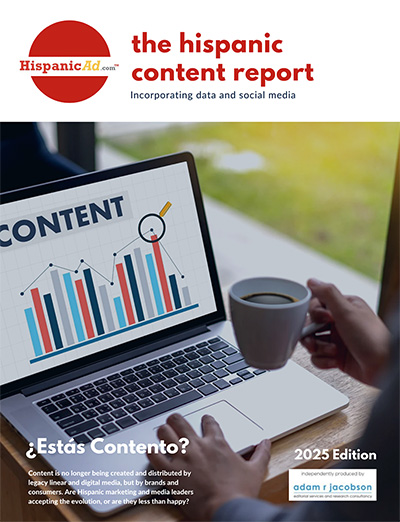
HispanicAd offers its annual report on key Content, Data & Social usage strategies, along with the importance of using Data strategies to engage the US Hispanic Consumer.
The HMC 2025 Hispanic Market Guide challenges marketers to follow the growth and prioritize cultural COMPETENCY for brand success [DOWNLOAD for FREE]
The Hispanic Marketing Council (HMC) has released its highly anticipated 2025 Hispanic Market Guide as a roadmap to help marketers effectively and authentically connect with the top U.S. growth market: Latinos. The guide features business-building cultural insights, economic and sector data plus reports on media consumption, purchase behavior and Hispanic creativity.
2026 Digital Media Trends: Capturing always-on fandom between releases and seasons

There are audiences, and there are fans. Fans represent a segment of consumers seeking long-term, consistent relationships with the intellectual property, artists, teams, and franchises they love.1 And while the media and entertainment industry is largely optimized around moments—blockbuster movie premieres, live sporting events, video game releases, and TV season launches—fandom isn’t experienced on the same schedule. Fans are willing to move across formats, platforms, and experiences during those big moments and in the “off-season,” in search of a continuity that they can’t experience otherwise. These fans may be signaling that the off-season isn’t a lull; it’s an opportunity.
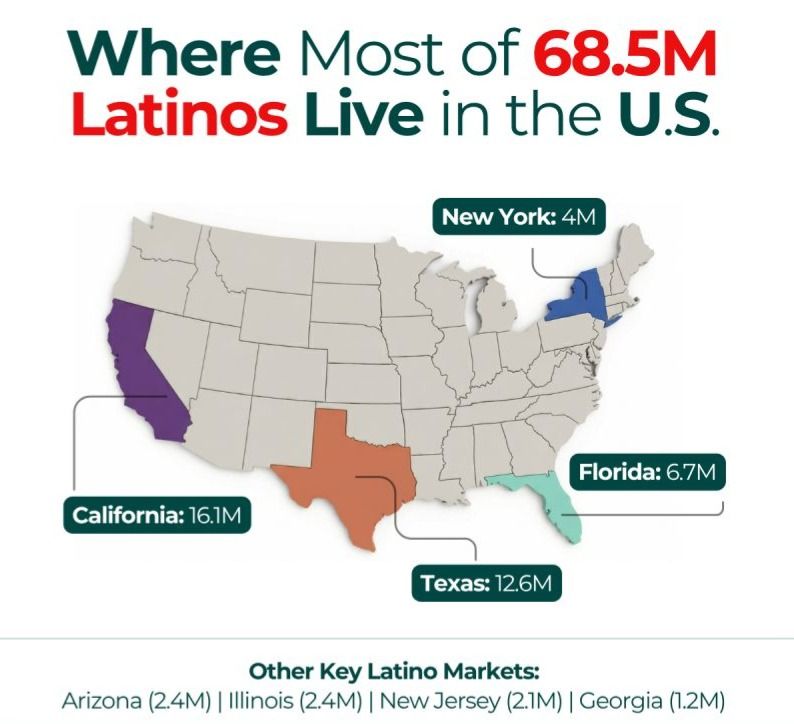
WHERE THE MOMENTUM REALLY LIVES – 68.5 MILLION STRONG. BUILT FOR SCALE. BUILT FOR THE FUTURE.