Grocers must rethink their growth strategies
 The pace of change in the grocery industry is rapid and the economics of the industry are challenging. While leveraging advanced analytics in all aspects of the operation was once a unique strategy for a few elite players, it is now a critical tool for grocers at large because profitability for the industry is highly dependent on a stable and growing top-line. Given the extremely thin margins of the average U.S. grocery retailer, missing out on a market share shift could be a critical mistake.
 Conviva’s Q1 2019 State of the Streaming TV Industry report findings show that while adoption of streaming is increasing, so is the complexity of achieving the goal of seamless video delivery at scale. Maintaining a high-quality viewer experience across content and advertising is increasingly important as streaming TV providers look to increase viewer retention and monetization.
 The growing popularity of social media took an unusual turn and has become one of the most effective advertising platforms.
 When it comes to setting benchmarks, there’s a lot of information to know and data to sift through, but they’re a necessary part of any consumer packaged goods (CPG) manufacturer’s business.
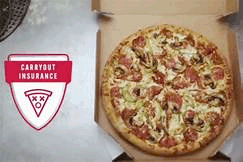 Accidents happen and that’s why Domino’s introduced its CARRYOUT INSURANCE® or SEGURO PARA LLEVAR, in Spanish, a free insurance for all carryout orders.
 It was 25 years ago this month, a Friday, May 20th, 1994, that Lisa Skriloff said goodbye to her colleagues at The New York Times where she was a Director of Marketing, gathered up her shoes from under her desk and left to start Multicultural Marketing Resources, Inc. (MMR) which opened for business the following Monday. She had a name for the company, an idea, a mission, a business plan in her head and a natural inclination towards optimism and, as she walked out that door in Times Square, a new chapter began.
 When you have worked with survey data for over thirty years – gulp – you take for granted things that other people do not. For instance, unlike many, I tend to assume that consideration and stated purchase intent questions do anticipate consumer behavior. However, I do not assume that an individual’s stated intentions will guarantee they buy the brand they state. by Nigel Hollis
 The Culture Marketing Council: The Voice of Hispanic Marketing pulls out the stops when it comes to delivering high-caliber content and featuring the biggest players in the multicultural industry as speakers—and the innovation and creativity tracks at the 2019 Annual Summit taking place at the Statler Hotel in Dallas on June 10-12 is also gearing up to be a show stopper.
 The ANA released a new report, “Enhancing Trust Between Marketers and Agencies,” in 2019 — for which 119 ANA client-side marketer members were polled.
 By Gonzalo López Martí – Creative director, etc. / LMMiami.com
 The number of foreign-born residents in the United States has ebbed and flowed over the past 165 years. By 2016, 13.5 percent of the U.S. population was foreign-born, a level that rivaled historic highs. But what has changed considerably over time is who the foreign-born are and where they have dispersed across the country, according to U.S. Census Bureau research.
 Since the dawn of the blockbuster era, commonly dated to the release of Jaws in 1975, media companies have operated on the principle that creating and launching the next big hit was the No. 1 goal. The rewards from success (box office receipts, international distribution, syndication, home video) were so immense that they more than justified the expense.
 Creative planning, media planning, and defining brand objectives often happen in siloed paths when kickstarting a creative campaign. When this happens, the marketer can end up with creative that does not align with the media plan or the brand objectives leading to ineffective campaigns, unnecessary change orders, and wasted money.
 Forbes Insights recently surveyed over 2,000 companies in the midst of a digital transformation, and found that those in CMO roles are best suited to driving digital revolution within their organizations. When encouragement to innovate and iterate comes from the top, it has a widespread impact on their teams and culture.
 In this modern age of entertainment, one screen is no longer enough to satisfy most. We forecast 180.8 million US adults will be two-screen viewers in 2019—meaning that 70.1% of the adult population will use a computer or mobile device to browse online while watching either digital video or traditional TV.
 Lebrón was previously Chief Creative Officer of República Havas in Miami. He will now be based out of Walton Isaacson Los Angeles, leading all work for that office as well as WI Chicago, Dallas and New York.
 Working Mother magazine has named the 2019 Best Companies for Multicultural Women—an honor recognizing U.S. companies that create and use best practices in hiring, retaining, and promoting multicultural women. This year, the list has expanded from 25 to 50 winners because applications more than tripled.
 The College Promise Campaign, a national nonprofit working to increase the number of quality College Promise programs providing paid-for college tuition and fees, released a landscape crosswalk of existing programs supporting Latino students during a convening of employers and higher education leaders in D.C. on May 8, 2019.