How Sharing Our Stories Builds Inclusion
 Conversations around inclusion are on the rise in 2021 following an intense and unprecedented two years. Converging events like the Covid-19 pandemic; the murders of Breonna Taylor, George Floyd, and Ahmaud Arbery; hate crimes against Asian and Jewish communities; and stalled progress among working women are creating an awakening in many organizations. But is this reinvigorated conversation translating to results? What’s the actual impact?
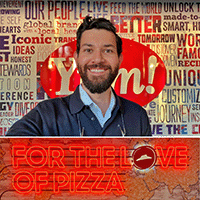 Federico Valiente, previously Director of Marketing for Dallas based Pollo Campero has been named Director of Marketing at YUM Brands for Pizza Hut LAI. Mr. Valiente was honored recently as one of HispanicAd’d 2021 Hispanic Market Thought Leaders.
 Observations, insights, and benchmarks for the modern marketer
 We explore consumer spending intentions across four categories for this holiday season, compared to previous seasons.
 Media quality issues, including increased risk and fraud, are the top challenges in programmatic advertising for marketers
 Agencies are in the service business. But you wouldn’t know it by calling a dozen agencies. Many of them will let your call ring until it rolls over to a general mailbox. And once you leave a message in that abyss, who knows whatever happens to it after that? Maybe someone will get back to you in a couple of business days? What kind of first impression is that? By Mark Duval – The Duval Partnership
 We’re still experiencing change from the pandemic as new consumer behaviors ripple through multiple sectors, some that will be with us for a long time. And new technologies and economic trends have sprung up as a result.
 Nielsen announced that it will enhance its National television measurement by measuring viewing in a more precise manner, allowing for a future where audience estimates are based on individual ads rather than commercial minutes.
 There is a controversy brewing in the Orlando Market in Florida, where a COX Radio is required to sell one of their FM radio stations by law based on the number of radio station they own in the market, they don’t feel they have the price they want during the required sell-off period dictated by the Federal Communication Commission and Spanish Broadcasting System (SBS) has placed a viable offer to purchase the radio station above the current valuation of the Orlando FM station on the table.
 Advertisers and marketers share a common goal: to understand the consumer path to purchase after seeing an ad or hearing about a brand.
 U.S. consumers once again have proven themselves to be highly resilient and adaptive during the Covid-19 pandemic. Their buying behaviors have evolved quickly and dramatically to address new priorities and limitations, with consumer spending growing solidly in most categories, according to a new report just published by the CMO Council.
 Marcela Gómez, the founding partner of the Culture Shift Team, talks about the importance of culture and innovation and the future of multicultural marketing on this episode of The New Mainstream podcast. As the head of CST’s multicultural marketing and public relations division, Marcela has worked with universities, public utilities, packaged goods companies, consumer, corporate, nonprofit, and business-to-business clients in transportation, education, government, banking, and health care.
 Undeterred, SBS moved ahead with making three all-cash offers, the final offer coming in ahead of the highest appraisal value presented by Bond & Pecaro. By Adam Jacobson – Editor in Chief
 mitú released the first of a series of studies titled The mitú InTell Series. The studies aim to gain and socialize insights on the current state of the U.S. Hispanic community while digging deeper into their motivations and behaviors behind topics ranging from health and wellness to finance, sports, food, commerce, and travel.
 With sustainability top of mind for many consumers, brands will need to improve communication to better connect with their customers’ values.
 You can’t deem yourself a thought leader. The market does that for you, and it only does that for you after you prolifically share ideas and stories that make people pause, follow, and share. Thought leaders also must have the experience — the cred — to validate their ideas. And finally, they should have a healthy mix of humility and pride. by Mariela Azcuy
 Is it wrong to wish on space hardware? So sang Billy Bragg in 1985 and his question was prescient: the 1990s saw a flurry of satellite activity with very smart people jumping into the space game with the dream of delivering broadband data to the underserved masses. Sound familiar at all?